Sealing off radiation and tritium in fusion facilities
A radiation-shielding composite could improve safety and maintenance in next-generation fusion facilities.

A flexible silicone rubber reinforced with lead tungstate (PbWO4) and boron carbide (B4C) could shield personnel from radiation exposure and contain tritium in future fusion facilities.
Researchers at Hefei Institutes of Physical Science of the Chinese Academy of Sciences claim to have developed the composite to meet strict operational requirements – reliable radiation shielding during fusion reactions as well as gas tightness and easy parts maintenance. This is particularly important for areas where pipes and other components pass through radiation-shielding structures.
Dr Huo Zhipeng explains the shift from studying rigid to flexible composites was due to the need for a strong seal that stops tritium leaking through holes in handling areas. The decision to reinforce the composite with lead tungstate particles and boron carbide was ‘primarily based on the fundamental principles of the interactions between radiation particles, such as neutrons and gamma photons, and materials.
‘The H atoms in the silicone rubber matrix first moderate fast neutrons, which are then absorbed by boron, an element with a large, thermal, neutron-capture cross-section. The attenuation of gamma photons is mainly related to the atomic number; therefore, Pb and W with high atomic numbers can effectively attenuate gamma photons.’
A bespoke experiment to test radiation-shielding capability indicates the composite can block 93.13% of neutrons and 82.76% of gamma rays at a thickness of 15cm – equal to, or better than, concrete, Zhipeng reports.
To fabricate the composite, the team first synthesise PbWO4 in an aqueous solution under magnetic stirring at 28°C for 30 minutes. After transferring the suspended mixture to centrifuge tubes and subjecting it to 8,000rpm, three cycles of centrifugation and redispersion are applied to alternately rinse the precipitate with ultrapure water and ethanol. Finally, they dry the purified precipitate at 60°C in a thermostatic oven for six hours to create a micro spindle-shaped PbWO4.
‘During the synthesis process, we found the reaction solvent affects the final morphology of PbWO4,’ Zhipeng explains. ‘PbWO4 obtained in an aqueous solution exhibited a spindle morphology, whereas that obtained in ethylene glycol solution was micron spherical.’
The researchers report choosing the spindle PbWO4 as the reinforcing filler because its aqueous chemical synthesis process is more environmentally benign.
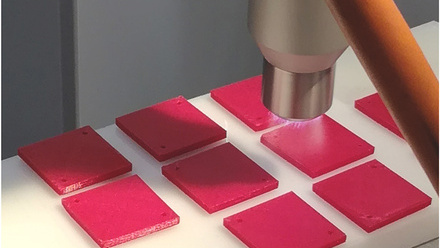
Zhipeng says they then weigh the reinforcing fillers and two-component silicone oil to the corresponding mass ratio and mix them, before the solution is transferred into a square mould.
Here, the materials undergo an hydrosilylation reaction at room temperature under the catalysis of chloroplatinic acid for 12 hours. This allows the two-component composite to crosslink and undergo curing before demoulding the final product.
‘During stirring, air is introduced into the silicone rubber, leading to voids in the cured composite,’ he reports. ‘By adjusting the stirring rate, time and other parameters, we reduced the voids in the composite as much as possible.’
Thermogravimetric analysis reveals the composite’s strong thermal stability, with an initial decomposition temperature of around 335.4°C. The stress-strain curves display typical brittle fracture behaviour, with tensile strengths below 1MPa, making the material suitable for sealing and maintenance.
In addition, 0.92MPa tensile strength and 5.32MPa compressive strength indicate it meets the mechanical and airtightness requirements for containing tritium. Finally, the spindle filler’s small particle size is found to reduce the composite’s thermal expansion coefficient significantly.
Zhipeng explains further research is required, including tests in a real tritium environment to study tritiated water surface contamination and evaluate tritium radiation degradation.
They also plan to use novel flexible polymer materials with higher hydrogen content as a matrix to further enhance the composite’s neutron-shielding performance.
More like this...